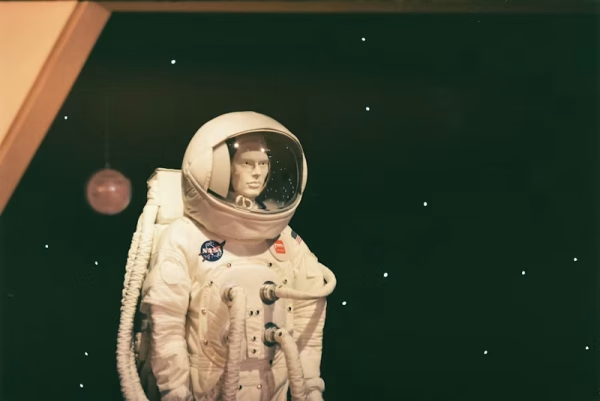
Imagine you wake up to put on your 300 lb billowy suit, traveling 17,000 miles away from Earth into the dark depths of the unknown outer space, to get up close with Earth’s one and only satellite, the moon, for the first time in 44 years. Would you worry about what you’re wearing? Or who you’re wearing?
Well, this was just the case for four of NASA’s astronauts who embarked on the Artemis II mission, a flyby of the moon. Though these astronauts didn’t worry about what they were wearing, and spacesuits aren’t exactly the definition of high-class fashion, how the future of space would affect our clothing and day to day life has always been a thought in pop culture.
The 50s marked the beginning of space travel, with the space race. A series of competitions against the United States and the Soviet Union during the Cold War, in an attempt to see who the true “master” of Outer Space was.
In 1955, the first satellite was sent to space, and 6 years later, in 1961, the first person was sent into space on a 108-minute orbit around the planet. Amidst the first man in outer space, President John F. Kennedy promised that a man would be sent to the moon and returned safely by the end of the decade. This brought people to imagine what life would be like while traveling in UFOs to work and throwing parties on Mars. The 60s started the pinnacle of space age fashion and pop culture, almost as if we were imagining our own dystopian future. This aesthetic has been coined as the term “retrofuturism.”
So what exactly is retrofuturism? It is described as “a vision of the future, from the past.” The 60s was filled with a generation of people who believed in the future, a future of advanced technological developments, and a life where all universes could come together.
The first signs of space travel made the world hopeful for what the world could become, as they watched Neil Armstrong walk on the moon, from their screens at home, they too couldn’t wait to be in his same position. The moon was a place away from war and political concerns, just a place where anyone could reach the stars.
First is the fashion of retrofuturism. The 60s marked a revolution in fashion, as shorter hemlines and the invention of miniskirts became popularized. The originator behind the retrofuturism aesthetic was fashion designer Andre Courreges.
In 1964, Correges dropped his “Space Age” collection filled with A-line dresses, go-go boots, mini skirts and even sunglasses with eyelashes, which quickly redefined the landscape of fashion for the rest of the decade. Courreges will forever remain as a powerful force in the fashion industry, as he demanded that women dress more comfortably, and more free. Instead of the heavy materials used in the 60s, he opted for a more modern approach by using vinyl, metallic fabrics and PVC. His designs focused on mobility, which may be due to his schooling background as an engineering student
“You don’t walk through life anymore. You run. You dance. You drive a car. Clothes must be able to move too,” Courreges explained in an article with the BBC.
He communicates this through his designs, by leaving the legs bare and leaving it looser at the waist. This almost left the idea that the models were alien-like creatures, orbiting through Earth’s solar system.
Courreges even invented the “Moon Girl,” which was his 1964 spring collection. This was filled with whites and silvers often paired with bold, colorful accessories.
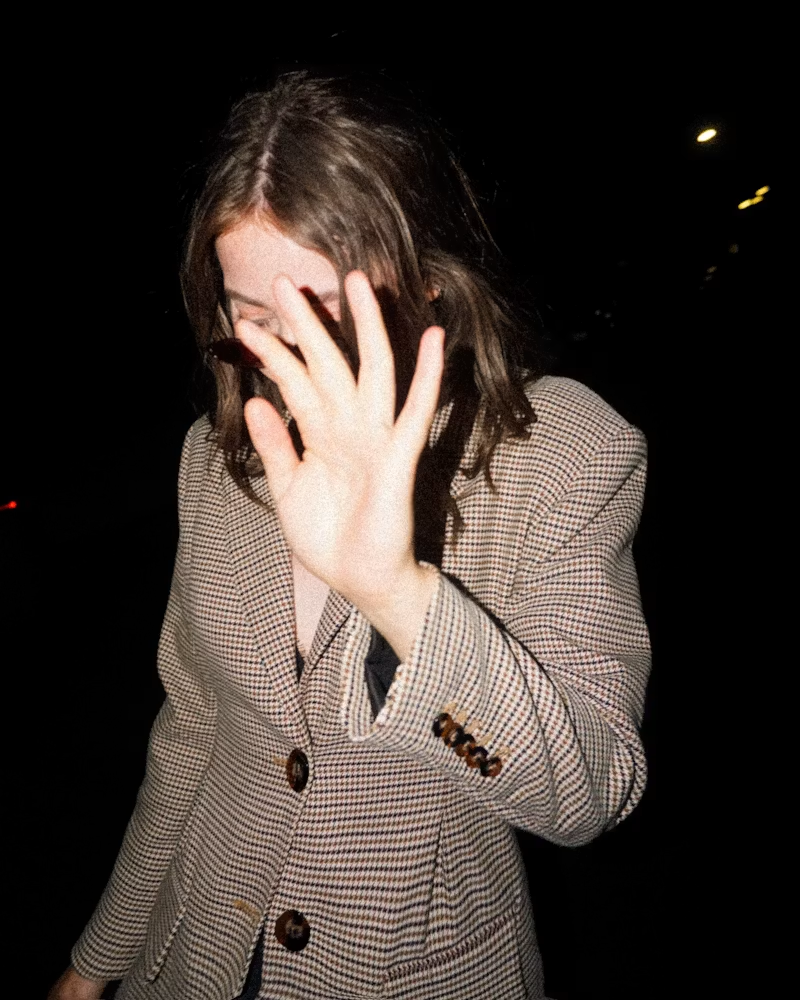
The style of retrofuturism and the moon girl was sported by many celebrities and fashion icons like Jackie Kennedy, who often wore the popular 60s, alien-eye sunglasses, that were inspired by the large, sharp almond eyes often drawn in alien illustrations.
This style also translated into TV shows and movies. Jane Jetson of “The Jetsons,” a cartoon about a family living in space, had a formulaic outfit sporting the flippy bob and the sharp geometric-shaped collar.
Now, you can’t discuss space-age fashion without the release of David Bowie’s album “Space Oddity” released in 1969. In this album, Bowie introduced his persona of “Major Tom” and described Major Tom’s mission as he went through Outer Space. Bowie took a different approach on space fashion by mixing funky patterns like geometric prints with animal patterns. He took a more psychedelic approach to outer space and introduced us to what would come in the 1970s.
As we continue to see space travel expand further and further into Outer Space, we can look at the style of the 1960s fondly, to remember that space exploration isn’t just about discovering what’s out there, but also about discovering one’s identity and remembering we too can reach the stars.
Support Student Media
Hi! I’m Hannah Planey, A Magazine’s editor-in-chief. My staff and I are committed to bringing you the most important and entertaining news from the realms of fashion, beauty and culture. We are full-time students and hard-working journalists. While we get support from the student media fee and earned revenue such as advertising, both of those continue to decline. Your generous gift of any amount will help enhance our student experience as we grow into working professionals. Please go here to donate to A Magazine.