
“Never in my wildest dreams did I entertain the idea that I would become a fashion designer,” Giorgio Armani said.
On Sept. 4, 2025, the fashion world lost one of its most transformative and talented designers when Giorgio Armani, of the high-end fashion brand Armani, was found dead in his Milan home at the age of 91.
In the middle of a blazing summer, Armani was welcomed into the world by his parents Ugo Armani and Maria Raimondi on July 11, 1934, in Piacenza, Italy. His childhood would be accompanied by Sergio, his older brother, and Rosanna, his younger sister.
Armani was faced with hardships early on, as he had to grow up during WWII. Poverty was plaguing everywhere, including the Armani home, and the flashy fashion trends of the ‘20s hastily dissipated in the face of the depression and were replaced with practicality and simplicity.
Despite the obstacles life threw at Armani so early on, he persevered and went out to pursue his dreams. Shockingly enough, fashion design is not the first profession Armani sought out.
Originally, he wished to work in medicine and he attended the Liceo Scientifico Leonardo da Vinci, a secondary school in Milan, with the hopes of gaining skills to prepare for a university setting. Then, by 1950, he was enrolled at the University of Milan in their department of medicine. However, three years into attending university, Armani enrolled in the military, and because of his medical expertise, he was assigned to the Military Hospital in Verona. This must have not satisfied the itch that Armani was trying to scratch with his medical career because shortly after this, he decided he desired a different path.
In 1957, after two short years in the military, Armani began working at La Rinascente, a department store in Italy that revolutionized ready-to-wear clothing being made available in stores; he performed the roles of sales clerk and window dresser. Here, he helped create the aesthetic personality of the store and thus began his dive into the deep ocean of fashion, where his eye for understated elegance and minimalism began to appear, which was a stark contrast to the bold and extravagant designs of his competitors.
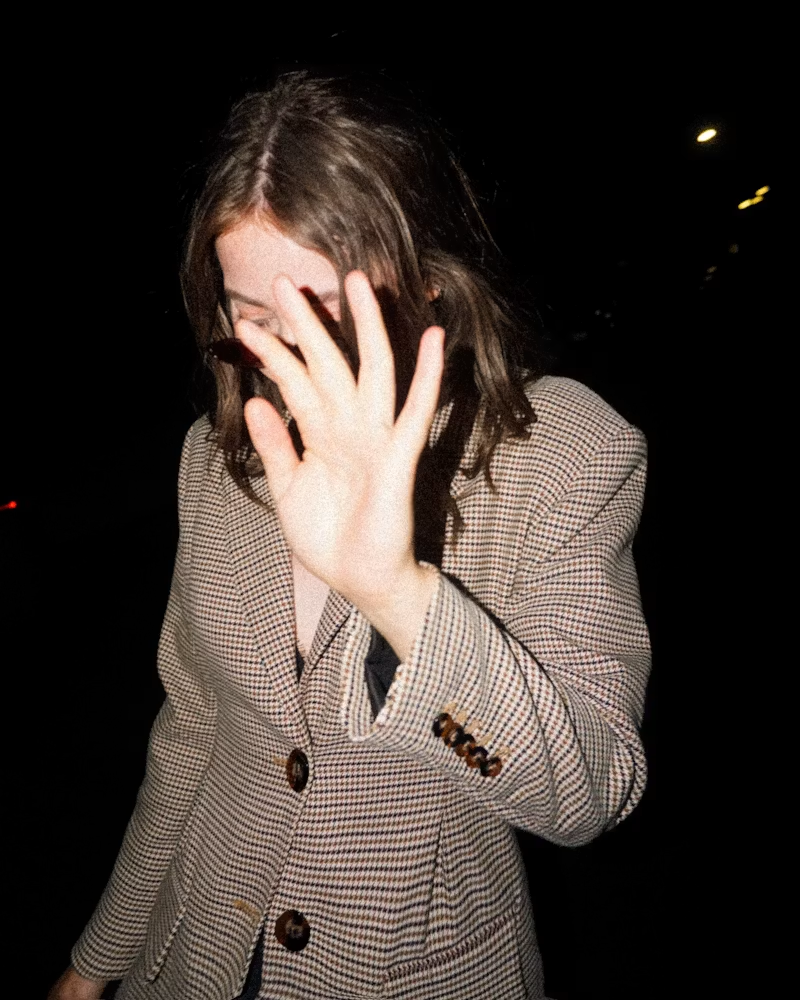
The skills Armani gained at La Rinascente quickly made him desirable to brands. He began designing for the Nino Cerruti brand in the ‘60s after his departure from La Rinascente. His role at the Cerruti brand was designing menswear, making these the first of many Armani designs. He stayed with the Cerutti brand for about six years (1964-1970), and in the midst of this era for Armani, he met his long-term business partner, Sergio Galeotti. Galeotti persuaded and pushed for Armani to start a design office in 1973. Armani began freelancing his skills to a myriad of fashion designers. This is where Armani started to perfect his design style and define himself as a designer. Through his fresh designs, he successfully redefined classic tailoring by toning down the firm structuring of the suit and created a signature soft silhouette.
Armani’s freelance fashion design debut was at the Sala Bianca couture show in the Pitti Palace in Florence. This paved the way for Armani to begin his own fashion brand, due to his fresh ideas and proficient skill levels in the craft. So, in 1975 he launched Giorgio Armani Spa with Galeotti. The brand commenced with only menswear designs but quickly expanded to creating womenswear a year later in 1976. His womenswear designs were a revolutionary step in women’s professional fashion. It offered women a new sense of power in their workplace that allowed them to take command while working without losing their elegance.
The Giorgio Armani Spa was universally known for its flexible, simple-yet-elegant and functional designs. It was considered to be revolutionizing menswear with its unstructured jackets because it was a new way of being able to dress professionally while also being fluid and comfortable. He showcased his first collection, under his own name, of ready-to-wear menswear in October of 1975. He carried these design points over to his womenswear collections, staying true to the integrity of professional wear but taking in consideration the body that was going into the clothes.
You have to wonder if Armani’s childhood during The Great Depression inspired his sense of minimalism and functional elegance in his designs, as they mirror many of the depression fashion values of being functional, not flashy, and Armani was able to include both.
Then, due to his medical background, he had insight to the functionalities of the body and he translated this knowledge into fashion. He emphasized an importance on clothing and movement, striving to make his fashion more functional. This is evident throughout all of his designs, even when he moved away from ready-to-wear clothes to haute couture.
After he created his brand, he rapidly gained attention and popularity. Armani believed film was a good way to market his designs and he was not wrong. He started designing costumes for movies and immediately took his brand to the next level. His first film-debut was in 1980 in the movie, “American Gigolo,” where he created actor Richard Gere’s costumes. After this, he became a global household fashion name, and went on to design for 100 more films. These films did not just feature Armani, it remodeled men’s fashion in film and reality, which secured his suits as the pinnacle of modern sophistication in fashion.
Armani would go on to be known for his diverse portfolio of brands, such as Emporio Armani and A|X Armani Exchange, as well as for popularizing fashion brands collaborating with celebrities for their red carpet looks and inventing the concept of lifestyle brands where products include fragrances, furniture, clothing and accessories. The success from these ever-growing brands and his transformative designs gained him the title of the King of Fashion.
Giorgio Armani’s legacy stretches beyond the fashion empire he built and the esteemed titles he received. He changed the definition of elegance and proved that simplicity can create power and sophistication, just as well or even better than his flamboyant competitors. The unstructured suits he designed freed men of stiff and fixed tailoring and his womenswear designs gave women the boost to command workplaces where they once were overlooked. Through film, he helped shape how the world envisioned fashion style. Armani did not just make clothes, he transformed a culture. He successfully created a timeless style of clothing of elegance, confidence and subtle power that will continue to inspire generations of fashion to come.
Support Student Media
Hi! I’m Hannah Planey, A Magazine’s editor-in-chief. My staff and I are committed to bringing you the most important and entertaining news from the realms of fashion, beauty and culture. We are full-time students and hard-working journalists. While we get support from the student media fee and earned revenue such as advertising, both of those continue to decline. Your generous gift of any amount will help enhance our student experience as we grow into working professionals. Please go here to donate to A Magazine.