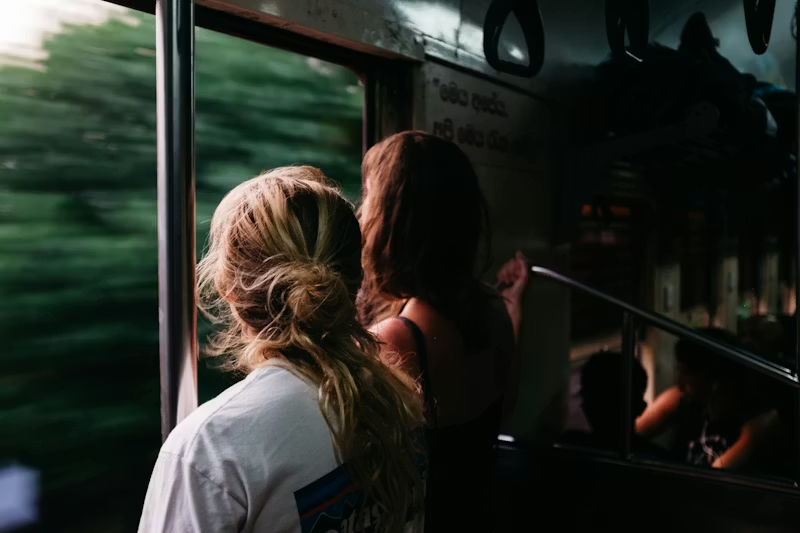

When people talk about college, they describe it as the time to “find yourself,” but for many young adults, it feels more like learning how to exist in the in-between. It’s a phase caught between independence and uncertainty when routines are new, familiar faces are gone and connection doesn’t come as naturally as social media makes it seem.
For Gen Z, growing up in an always-online world has created a strange contradiction. They are more connected than ever, yet more isolated than any generation before them.
According to Tara Zirkel of EAB, college students today are entering higher education with increased feelings of loneliness, anxiety and disconnection. It’s not that they don’t want community, it’s that finding it has become harder to navigate in a culture that values visibility over vulnerability.
Loneliness in college has become so common it’s almost expected: walking into a lecture full of strangers, eating lunch in a crowded dining hall while pretending to scroll through your phone, the half-familiar faces that never quite turn into friends. Moments like these have become the backdrop of college life for many Gen Z students, a generation more connected yet more isolated than ever before.
As Active Minds explains, loneliness isn’t a personal flaw, it’s a signal. It’s a reminder that connection is something humans are wired for, even when it feels out of reach.
Community doesn’t appear overnight. It often begins quietly with a familiar face in class, a weekly club meeting or an invitation to grab coffee after a study group. These small, everyday interactions are the foundation of belonging, yet many students hesitate to take the first step. The fear of being judged or ignored can be paralyzing in an age when every interaction feels performative.
Her Campus writer Isabella Licwinko recently explored Gen Z’s growing lack of “third places,” casual spaces outside of school and home where connection naturally forms. Coffee shops, campus clubs and library corners once served as gathering points for conversation and friendship.
Today, many of those spaces are overshadowed by digital ones, leaving fewer opportunities for organic interaction. Maybe it starts with something simple like talking to the person next to you in class, staying a little longer after a meeting or just showing up.
Those small, real-world moments are what make campus start to feel like home. Finding connection requires courage, but not perfection. It’s about showing up, even when it’s uncomfortable. Every introduction, every brief conversation, every time someone chooses to stay instead of leaving early, all adds up. The act of being present is often enough to bridge the initial gap between isolation and belonging.
For this generation, community might look different than it did in the past. It doesn’t have to be a large, inseparable friend group or a constant social calendar. It can be one consistent person to talk to, a study group that becomes a weekly ritual or a small club where names and faces begin to feel familiar.
College can be lonely, but it’s also one of the few times in life where everyone is quietly searching for the same thing: connection. The challenge and the opportunity is learning to reach for it, even when it feels easier to retreat.
Maybe the goal isn’t to “find yourself” after all. Maybe it’s to find your people, the ones who make self-discovery feel a little less lonely.
Support Student Media
Hi! I’m Hannah Planey, A Magazine’s editor-in-chief. My staff and I are committed to bringing you the most important and entertaining news from the realms of fashion, beauty and culture. We are full-time students and hard-working journalists. While we get support from the student media fee and earned revenue such as advertising, both of those continue to decline. Your generous gift of any amount will help enhance our student experience as we grow into working professionals. Please go here to donate to A Magazine.