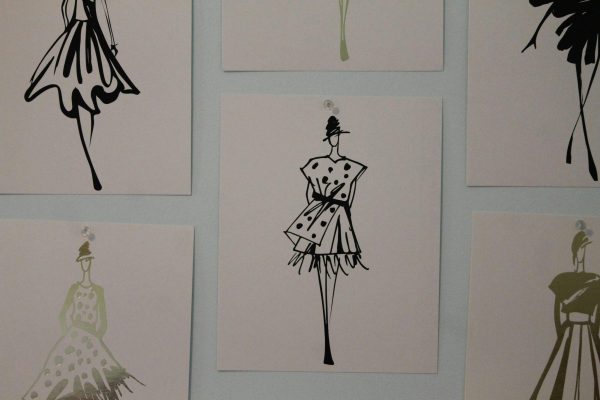
When Coco Chanel said, “Fashion is architecture: it is a matter of proportions,” she likely didn’t foresee that tomorrow’s fashion architecture might be drafted not in charcoal and muslin, but in prompts and pixels. In 2025, the world of fashion is quietly being re‑sketched by artificial intelligence: from text‑to‑image tools like Midjourney to generative design platforms that spin up silhouettes, fabrics and prints in seconds. Are we heading toward a future in which collections are prompted, not sketched?
Across the fashion world, opinions on AI’s role diverge sharply. British designer Jonathan James William takes an uncompromising stance on the role of AI in fashion. In an interview with New Wave Magazine, he stated bluntly, “Using AI to design clothes is soulless and has no place in fashion design.” For William, the heart of fashion lies in human creativity, intuition, and emotional resonance, qualities that algorithms simply cannot replicate. He argues that fashion is more than just aesthetics or functionality; it is a reflection of culture, personal experience and artistic expression. To reduce it to a series of computational outputs, he warns, risks stripping the industry of its very essence, creating garments that may be technically precise but utterly devoid of personality, narrative, or soul. In his view, the human touch in design is irreplaceable, and any attempt to substitute it with AI not only undermines the craft, but also disconnects fashion from the emotional and cultural stories that give it meaning.
That push-and-pull captures a central tension in fashion today: if a designer uses an algorithm to generate silhouettes or prints, who is the author? The human or the machine? Tools like Midjourney, Runway or CLO3D are now capable of producing runway-ready concepts in minutes, drawing from massive image datasets. Critics argue they risk harvesting aesthetics without proper provenance. As Aire Thorne put it in Daisy Chain: “Human influence has boundaries. We reference. We credit. We build community around shared practices. We don’t scale mimicry into infinite replication, remove attribution, and package it for profit. AI doesn’t riff, it reconstructs.”
Meanwhile, fashion education is racing to adapt. At Kent State School of Fashion, instructor Lauren Copeland explained in Kent State Today, “It really is a lesson of back and forth. ‘How do I get familiar with the technology?’ But then, ‘How do I find a way to harness the technology to my benefit?’ There is always going to need to be that creative sense of a person putting themselves out there through fashion.” In Italy, Polimoda students echo a similar sentiment: “AI can produce incredible design and artwork that gives us a lot of pleasure, but that’s not the only part that matters. An innate and unique human quality is the ability to contextualize, and tell a story about something.” The implication: schools are not just teaching AI tools but asking how humans remain central in a technology-accelerated workflow.
Of course, the human touch remains irreplaceable. A sketch becomes pattern-cut muslin, a digital print must be dyed on fabric, a model must walk the runway. Wong sums this up plainly: “A dress isn’t real until someone feels it on their skin. You can’t prompt that.” Fashion at its best is a story told in fabric, form and emotion, not just pixels. AI may accelerate or amplify that story, but it cannot feel it.
The next generation of designers may need to be fluent in both fabric and algorithm, sketching not just with pencil but with prompt, while the conversation between human and machine is only just beginning.
Support Student Media
Hi! I’m Hannah Planey, A Magazine’s editor-in-chief. My staff and I are committed to bringing you the most important and entertaining news from the realms of fashion, beauty and culture. We are full-time students and hard-working journalists. While we get support from the student media fee and earned revenue such as advertising, both of those continue to decline. Your generous gift of any amount will help enhance our student experience as we grow into working professionals. Please go here to donate to A Magazine.