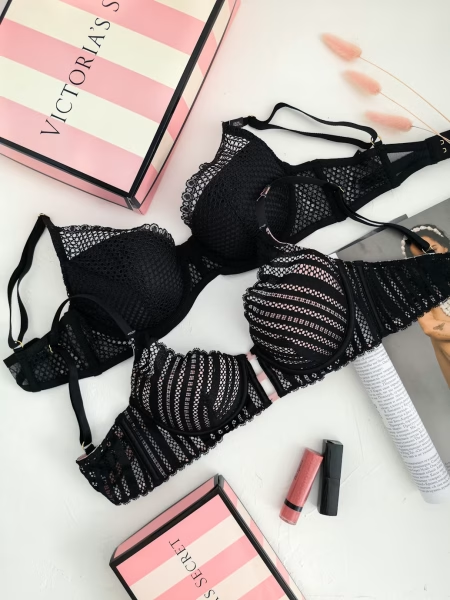
Voluminous blowouts, sparkling wings and most importantly, the lingerie, are trademarks of the ever-iconic Victoria’s Secret Fashion Show. Whether you love it or hate it, you definitely know it, and it is the “Super Bowl” for most fashion majors.
The Victoria’s Secret Fashion Show has a lengthy history, beginning with the first show in 1995, held in New York City’s Plaza Hotel. Victoria’s Secret, which started as a brand just found in malls, began their fashion shows as a way to market their latest collections of bras, underwear and lingerie on a much larger scale. It grew into more of a stage production rather than just your typical fashion show, part of the reason why the Victoria’s Secret Fashion Show became a cultural phenomenon.
Women of all ages would gather around the TV, watching models strut down the runway in their oversized wings. Starting in 1996, Victoria’s Secret’s Fantasy Bra became another highlight of the show, with one model being chosen to model a bra designed with jewels worth millions of dollars.
Throughout the 2000s and 2010s, the Victoria’s Secret Fashion Show continued to evolve, featuring performances by high-profile musical guests including Taylor Swift, Ariana Grande, Lady Gaga and Harry Styles, among others.
The models for the fashion show, affectionately known as Victoria’s Secret Angels, became celebrities in their own right. These supermodels became the faces (and bodies) of the brand, and fans were quick to pick their favorites.
Whether it was Adriana Lima, Gisele Bundchen or Heidi Klum, one thing was true: these models were a part of a beauty standard that was unreachable to the general public. This raised concerns in the media, with the presentation of unrealistic standards that were harmful to impressionable young women who looked up to these models.
Part of the product Victoria’s Secret sells with their fashion shows is a fantasy, and this is demonstrated through their choice in models. The disclusion of any model who did not fit this ultra-narrow beauty standard was a statement in itself. Although plus-size model Ashley Graham and transgender model Alex Consani made their debuts in the 2024 show, this didn’t make Victoria’s Secret an inclusive brand all of a sudden, and it certainly didn’t erase the words of past executive employees.
In 2019, the show was cancelled due to a decrease in viewers, and a mission to “evolve the marketing of Victoria’s Secret,” according to L Brands chief financial officer Stuart Burgdoefer. This led to an outpouring of opinions, with some relieved that the impractical standards that the show set were on hiatus, while others were in mourning of the fashion-filled spectacle they looked forward to each and every year.
After five years on pause, the Victoria’s Secret Fashion Show came back in 2024, but not to the liking of many fans that had fallen in love with the original shows. The show received backlash due to a turn from the playful, ultra-feminine aesthetic it was formed on.
The 2025 Victoria’s Secret Fashion Show occurred on Oct. 15, and it was amazing to see inclusion of all types of women, from WNBA player Angel Reese and influencer Quenlin Blackwell, to many of the Victoria’s Secret Angels of the past. The references to previous shows were abundant, yet with a modern and fresh twist.
While some may believe that the Victoria’s Secret Fashion Show is overtly targeted to a male audience, I see it as a celebration of womanhood, depicted by models in wings blowing kisses to each other on the runway.
Due to changing times and cultures, the Victoria’s Secret Fashion Show and its Angels will never look the same as it used to back in the early 2000s, and it can not be expected to. I believe that Victoria’s Secret can continue to embrace diversity and empowerment, while also staying true to its sexy, feminine-focused roots.
Support Student Media
Hi! I’m Hannah Planey, A Magazine’s editor-in-chief. My staff and I are committed to bringing you the most important and entertaining news from the realms of fashion, beauty and culture. We are full-time students and hard-working journalists. While we get support from the student media fee and earned revenue such as advertising, both of those continue to decline. Your generous gift of any amount will help enhance our student experience as we grow into working professionals. Please go here to donate to A Magazine.