
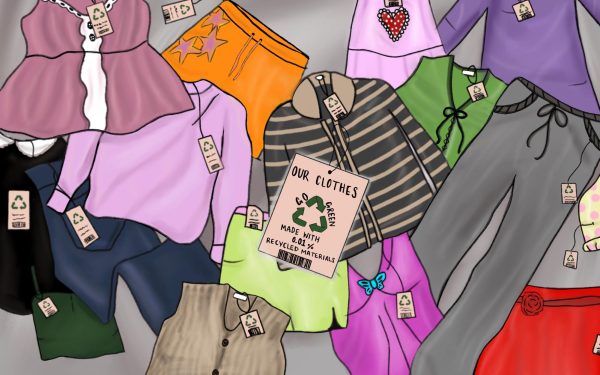
In the ever-growing sustainability-driven world, companies must keep up with consumer demands to be more eco-friendly, however, many brands use “green” marketing strategies to appear more environmentally friendly without following through on these sustainable practices.
This is what is known as greenwashing. Greenwashing has been an increasingly popular marketing tactic by clothing companies that cannot uphold the requests of more sustainable practices, so instead, they lie in order to keep the profits from environmentally-conscious consumers rolling.
This poses a significant problem in terms of trying to combat climate change. Due to the consumption of unethical products under the guise you are doing something good for the environment, the effects these unethical practices have on the environment will continue and even increase.
Generating high amounts of waste and overproducing products are a couple of these practices. The companies will cover up their tracks by claiming that they are recycling, but with no proof. Alternatively, their recycling process ends up being ineffective, leading to clothes still going to the landfill.
Fashion Design and Merchandising Assistant Professor Narmin Nasibli said that companies need to go through many steps in order to be more sustainable. It is difficult, but possible.
“To be truly sustainable, you have to do a systematic change,” Nasibli said. “You have to change your whole supply chain, the vendors that you are working with, you have to do auditing, you have to get all of the certifications to be really sustainable and that’s very costly for companies.”
The UN has developed Sustainable Development Goals (SDGs) to address sustainability problems within companies. These incorporate 17 goals that convey environmental, social and economic challenges. These aid companies to position themselves in more sustainable practices.
This has led to the creation of the environmental, social and governance reports (ESG). These reports must meet the outlined requirements of the company’s contribution to the environment, including things like their commitment to transparency, ethical business and sustainability practices. So, consumers are not the only demographic these companies need to appeal to.
“To meet the consumer demands and to meet the ESG requirements, companies have to do something about sustainability,” Nasibli said. “That’s where greenwashing comes in because to be truly sustainable it requires a lot of resources and not every company can do it because of their profits.”
As a result companies will choose a particular aspect of their business and market it as sustainable, hiding the unethical practices.
“That’s usually fast fashion brands, they do not disclose all unsustainable practices, but rather focus on one thing and make it trendy,” Nasibli said. “That trendy thing right now is the recycled fabrics, but is it really, truly recycled?”
These companies are using language that deceives consumers and they will even include these statements in their ESG reports, they use mind tricks to their advantage. Most consumers are not thoroughly researching a company’s practices, so when they see that something is recycled, they assume it’s sustainable.
“In their ESG reports, they always say, in five years we’re aiming to get our whole production made by 100% recycled materials,” Nasibli said. “We don’t know their current situation, so you look and see 100% and think that means they’re good, also not just language, but a trick they use is adding green color and consumers subconsciously think it is [sustainable].”
Consumers have the power to practice sustainable consumption habits all of the time, this would help the cause as the unethical businesses would not gain more profits. Unfortunately, due to companies’ trend of hiding and using confusing language, we don’t see any change in numbers because consumers believe they are practicing sustainability.
“Consumers are a good part of it, but it’s not the major part,” Nasibli said. “They do have attitudes toward sustainable products, they have intentions, but when we look at the numbers they do not purchase these [eco-friendly] products.”
This could be due to the fact that companies are greenwashing, but the economic state of the world also plays a big role. If prices go up, consumers are more likely to seek out the cheaper, unethical products.
“If it is cheaper, consumers prefer that,” Nasibli said. “When purchasing any clothing, the first thing consumers prioritize is style, then price, and sustainability is always last among the priorities of consumers.”
Consumers have also shown a disinterest in a lot of actually environmentally-friendly products, as they may be dull to them or out of their price range.
“Consumers complain about sustainable products being boring,” Nasibli said. “So you cannot make the decision environment very difficult for a consumer and expect them to follow through [sustainably].”
It is difficult to push companies towards these practices because of how popular fast fashion is for consumers. It is cheaper, it offers a range of styles and it is easy to obtain.
“We need policies to encourage companies to change their whole model,” Nasibli said. “That’s difficult because fast fashion is very profitable.”
The future of sustainability in companies requires a total shift in the system. It is slowly but surely starting with new policies being put in place that drive companies to aim for more sustainable practices.
“For the future, we can force companies to build products that are meant to last longer,” Nasibli said. “These policies place all companies responsible for their entire supply chain, it should be some period of time before we see if they actually work out.”
Support Student Media
Hi! I’m Hannah Planey, A Magazine’s editor-in-chief. My staff and I are committed to bringing you the most important and entertaining news from the realms of fashion, beauty and culture. We are full-time students and hard-working journalists. While we get support from the student media fee and earned revenue such as advertising, both of those continue to decline. Your generous gift of any amount will help enhance our student experience as we grow into working professionals. Please go here to donate to A Magazine.