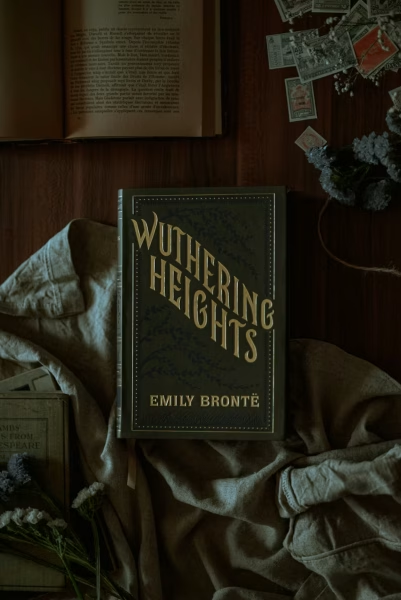
“Whatever our souls are made of, his and mine are the same.” The line, first written in 1847, has lived in the pages of “Wuthering Heights” for nearly two centuries. Now, it lives again, this time on signet rings, red carpets and the newest film adaptation starring Margot Robbie and Jacob Elordi. What began as a gothic romance has evolved into a modern cultural moment, blending literary legacy and a press tour that has sparked just as much conversation as the film itself.
For those of you who haven’t seen the film yet, it is a gothic romantic drama, set in the late 19th century, primarily covering the first half of Emily Brontë’s original novel. This adaptation is not quite a page-for-page accurate adaptation but is “more of an interpretation of the feeling Emerald had at 14 while reading the book,” said Margot Robbie on Jake’s Takes.
Fennell, an English director, writer and producer who first launched her career in 2020 with her feature film “Promising Young Women,” had been thinking about doing a “Wuthering Heights” adaptation during her days of filming her film “Saltburn” that released in 2023. As you probably have noticed, the actor Jacob Eloridi, who plays Heathcliff, and the actress Allison Oliver, who plays Isabella Linton, have both worked with her previously on “Saltburn” and were both brought back due to her vision. Fennell first had the vision to cast Elordi as Heathcliff after seeing him with sideburns for his character Felix Catton. She told British Vogue “I was like, ‘Oh my God, it’s the Heathcliff on the cover of the book that I’ve had since I was a teenager.’”
This decision has stirred up controversy for many readers of the original novel because although Heathcliff’s racial identity is left ambiguous, many readers say that he is clearly not white, and that Heathcliff’s racial identity is central to the social barriers between him and Catherine.
“In the book it’s not explicitly said what race Heathcliff is but he’s not white, so I was really upset they cast a white man because a big part of the book and the fact that they couldn’t be together was because he wasn’t white,” said senior journalism major, Lauren Cohen at Kent State University.
“When he comes back and he’s rich, it’s not as realistic that they can’t be together. The reason was because of the societal expectations at the time,“ Cohen said. “Adding to this, viewers also noticed that the actor who played Edgar Linton was of Pakistani descent, which further shifts the racial dynamics established in the novel.
As far as how the characters were represented overall, some readers felt the emotional depth between Heathcliff and Cathy was lost in the film and was oversexualized. Also, important characters were left out, leaving certain arcs to be unfinished or interpreted differently.
“The characters were not as three-dimensional as in the book. There was a lot more of an emotional connection between Cathy and Heathcliff in the book and it wasn’t as physical as it was portrayed in the film,” said Cohen. “Cathy was very entitled and rude in the book, she had moments in the film but it wasn’t as bad. The movie almost made you feel bad for her.”
These concerns about flattened characterization become even more evident when examining who was excluded from the adaptation altogether. One of the most significant omissions was Cathy’s brother, Hindley, whose presence in the novel plays a crucial role in shaping Heathcliff’s transformation.
“Cathy had a brother named Hindley in the book. He tortured Heathcliff their entire childhood and then grew up and Heathcliff became Hindley in a way, which would have been a really interesting character arc that they could have added to this adaptation,” said Cohen.
While in the book Hindley is the primary antagonist and catalyst for tragedy, you could say that Fennell’s version had Nelly as the primary antagonist who was the main obstacle between Heathcliff and Cathy. Nelly is portrayed as jealous, bitter and doing whatever she can to obtain a better life for herself. So when Edgar Linton’s riches are brought to her attention, she will do whatever it takes to keep them apart. This shift changed the dynamics of conflict but also opened space for Fennell to create a world that feels visually alive and layered.
This is where Fennell’s signature approach to theatricality really shines. Drawing on her history with stage and set design, she brings every scene to life. “Fennell’s film has a heightened theatricality. The costumes, impressive set design and lighting all suggest an expressionistic take on the story which privileges the uncontrollable emotions of the characters,” said Beth Daley for The Conversation. The world she created wasn’t just a backdrop, it is an active part of the story reinforcing character motivations and emotional intentions while giving the audience a fully immersive experience.
“The Linton’s house was so beautiful, that is exactly how I pictured it and all of the small details they included, like the wall that was the color of her skin and all the weird off putting decorations, I think were really smart to put in cause it does make you feel uneasy and that’s kinda how it’s supposed to make you feel,” said Cohen
This attention to visual storytelling carries naturally into the actors’ interactions during the press tour. In January of 2026, Margot Robbie told Fandango in an interview that she felt co-dependent working with Jacob on this film and described the feeling as a “kid who’s lost her blanket.” In the same interview, Elordi confessed that he felt the same and that they had a mutual obsession with each other. Some fans believe this to be a promotional bit to help viewers get attached to their characters, Cathy and Heathcliff, in the film. Others believe it to be strange behavior similar to other press tours such as Glen Powell and Sydney Sweeney in “Anyone But You” or Ariana Grande and Cynthia Erivo in “Wicked.” Besides Elordi and Robbie’s words of affirmation to each other, the two have been spotted holding hands, exchanging looks during interviews and being very close to each other.
This film’s production took place over the first four months of 2025 and was released on Feb.13, 2026 meaning the two have practically spent two Valentine’s Days together. Robbie told Vogue Australia about Elordi’s thoughtful gesture of covering her entire bedroom with roses and a handwritten note from Heathcliff’s character.
“I remember thinking on Valentine’s Day, oh he’s probably a very good boyfriend, ’cause there’s a lot of thoughtfulness in this,” said Robbie. “You did a lot of very thoughtful things. It wasn’t just the gesture of the roses, it was the thing written from Heathcliff, and that little tombstone thing. I was like, ah, crafts! Love that. It was crafty, it was meaningful, it was dramatic.”
One thing that stayed true to the novel is the famous quote, “Whatever our souls are made of his and mine are the same,” spoken by Catherine, it signifies the intense and almost obsessive connection her and Heathcliff have, a love rooted in shared, fundamental essence rather than mere affection.
The saying was engraved on signet rings ahead of the film’s press tour, gifted to Elordi by Robbie according to People Magazine. “The chunky gold rings feature two hand-enameled skulls locked in an embrace and surrounded by thorns, ‘to symbolize both bittersweet love and the harshness of nature,’” per Vogue. It also included the characters’ initials “C” and “H” and the years 1847-2026 to reference the year the book was published and this release. By engraving the novel’s most famous line into gold and carrying it from set to red carpet, the actors transformed a 19th-century love story into a 21st-century moment.
Despite this film’s controversy, Fennell was truly brilliant, and beautifully crafted this piece to her own imagination. While it is different from Emily Brontë’s original it leaves room for conversation and gives opportunities to both the actors in this film and everyone that had a piece to do with it. This is only the first half of Brontë’s book, leaving some of us wondering if there will be a sequel.
Support Student Media
Hi! I’m Hannah Planey, A Magazine’s editor-in-chief. My staff and I are committed to bringing you the most important and entertaining news from the realms of fashion, beauty and culture. We are full-time students and hard-working journalists. While we get support from the student media fee and earned revenue such as advertising, both of those continue to decline. Your generous gift of any amount will help enhance our student experience as we grow into working professionals. Please go here to donate to A Magazine.