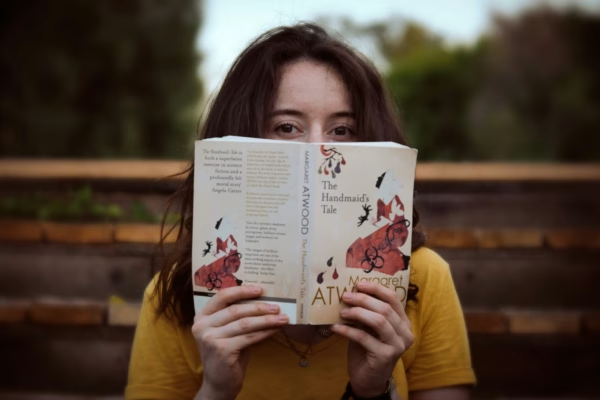
After the results of this past presidential election, it was difficult not to feel helpless and disheartened about the future of the country. I started obsessively binging “The Handmaid’s Tale” with one of my best friends as a sort of act of rebellion and defiance against our real anger. At first glance, it seems bizarre to escape one dystopian existence through another, but it has been so empowering to watch these incredible female characters endure all that they have and continue to fight for themselves and their rights in the face of so much oppression and I recommend all women watch it.
Understandably, the content can be triggering for some viewers, so by all means protect your peace if it may be unhealthy for you to watch, but the actors and showrunners are so thoughtful and sensitive when it comes to the frightening, potential reality behind their fictional world.
The premise of the series, for those who are unaware, is that a totalitarian dictatorship has risen to power in America, and in the newly formed nation of Gilead, fertile women are deemed “handmaids” with the sole purpose of carrying the children of the nation’s men.
“The Handmaid’s Tale” is also a book published way back in 1985 by Margaret Atwood. Atwood has been an important crew member and consultant for the entirety of the show’s run and it is remarkable and frightening to see how women’s rights have depleted since the book’s initial publishing, proving that the corruption of male power is a folly as old as time and women will always pay the price for it.
“I made a rule for myself: I would not include anything that human beings had not already done in some other place or time, or for which the technology did not already exist,” Atwood stated on Lithub.com. “I did not wish to be accused of dark, twisted inventions, or of misrepresenting the human potential for deplorable behavior. The group-activated hangings, the tearing apart of human beings, the clothing specific to castes and classes, the forced childbearing and the appropriation of the results, the children stolen by regimes and placed for upbringing with high-ranking officials, the forbidding of literacy, the denial of property rights—all had precedents, and many of these were to be found, not in other cultures and religions, but within Western society, and within the ‘Christian’ tradition itself.”
Atwood’s perceptions into the political and social behaviors of the world around her were ahead of her time, by taking inspiration from such historical events from the ‘80s, like “the rise of the Christian right in America during the 1970s and ’80s, the Islamic revolution in Iran in 1979.” While the book is a reflection of the times she lived through, the series premiered in 2017 and the political parallels and symbolism are still relevant today, especially seeing as the show has now lasted through two different eras of the Trump administration.
“No, I don’t think any of us could have predicted how closely the show would maintain its relevance and continue to reflect real events,” said showrunner Eric Tuchman to CNN reporter Oliver Darcy for his “Status” newsletter. “The series has been called a cautionary tale about what can happen when power is abused and people’s rights and freedoms are stripped away. But that warning was ignored, apparently, by the majority of voters, and Roe v. Wade was overturned. Women in our country have fewer rights now than when we started production in 2016.”
Tuchman goes on to say that while the goal behind “The Handmaid’s Tale” writers is not to create a response to modern political headlines, he suggested “the fact that their struggles on the show can sometimes feel eerily relevant to the real world is the result of us trying to write honestly about power, resistance, and how fragile our democracy and freedom are.”
Even beyond the overturning of Roe v. Wade, Trump’s recent comments about women carry the spirit of a Gilead uprising, as he called himself the “fertilization president” back on March 26 during a White House Women’s History Month event. During this speech, he rambled about IVF and birth control, claiming he was going to make waves in the field of providing expedient mothers and current mothers with money and resources, thus, in his world, encouraging all women to have children. However, he failed to provide any concrete plan for where this money and these resources will be coming from.
A part of the conservative agenda that was a huge ticket time for voters this past election has been reproductive rights and health care, and while motions providing extended maternity leave for new mothers sounds great in theory, none of these current male politicians actually want to look out for women and mothers and just want to put an end to abortion and keep women in controlled submission. Liberal women are also constantly misrepresented as being anti-family and anti-children, when in reality their stance is not to end the “nuclear family” but to leave the decision to start it entirely up to the mother. The issue isn’t all women should never get pregnant, but that all women should have a say in how and when.
We approach “The Handmaid’s Tale” when we decide that the act of reproducing should be mandatory and non-consensual for women. Our main protagonist of the series, June Osbourne, had a husband and a daughter before Gilead stole her away from them to be a baby machine and so much of her strength and fearlessness is derived from her love for her family and her mother’s instinct pushing her to fight harder to destroy this regime and get her daughter Hannah back. June isn’t anti-babies because she is a feminist; she is a feminist who made the choice to have a baby and knows the value of that choice firsthand.
As stated above, “The Handmaid’s Tale” was never meant to make direct references and comments about the current political state of the world or even the Trump administration, but the ability to draw parallels and comparisons to our real life situation is extremely telling and occasionally impossible to ignore. Women’s rights in this country have been and will continue to be under attack and it is so important to remember to use your voice and vote when you can.
In the meantime, despite how stories like “The Handmaid’s Tale” can seem terrifyingly inevitable, the stories of these women and their resilience and unity in the face of oppression can be so inspirational and motivating to watch unfold. Definitely jump on Hulu and give this show a chance, and remember that women are stronger together.
Support Student Media
Hi! I’m Hannah Planey, A Magazine’s editor-in-chief. My staff and I are committed to bringing you the most important and entertaining news from the realms of fashion, beauty and culture. We are full-time students and hard-working journalists. While we get support from the student media fee and earned revenue such as advertising, both of those continue to decline. Your generous gift of any amount will help enhance our student experience as we grow into working professionals. Please go here to donate to A Magazine.