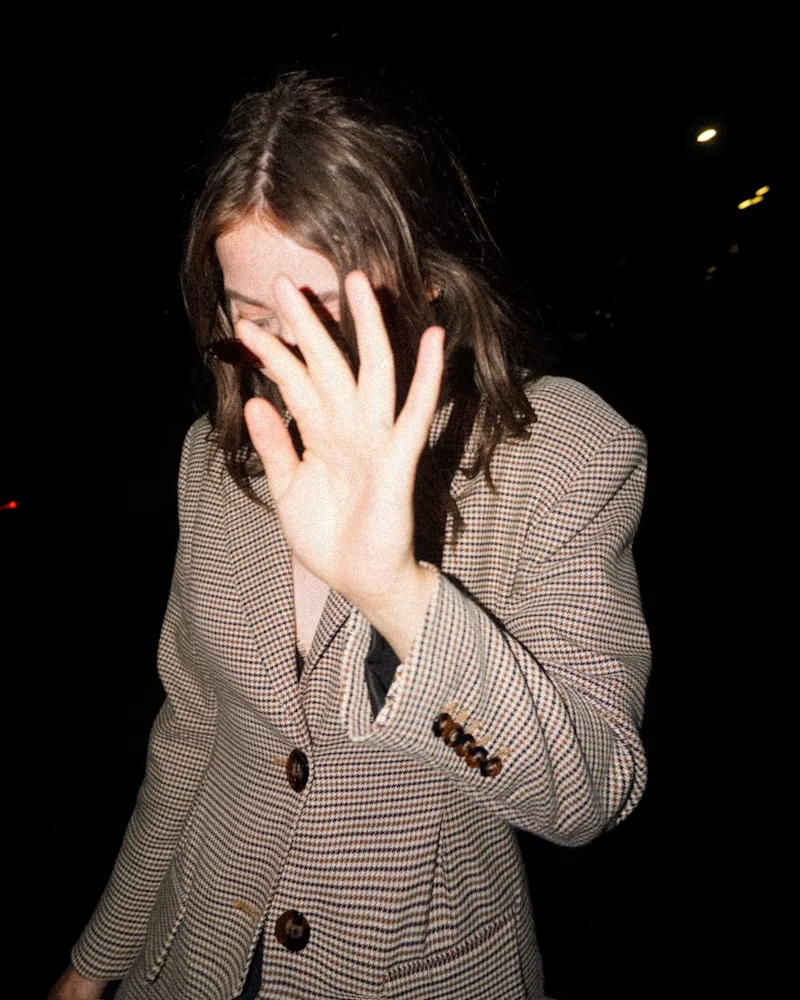
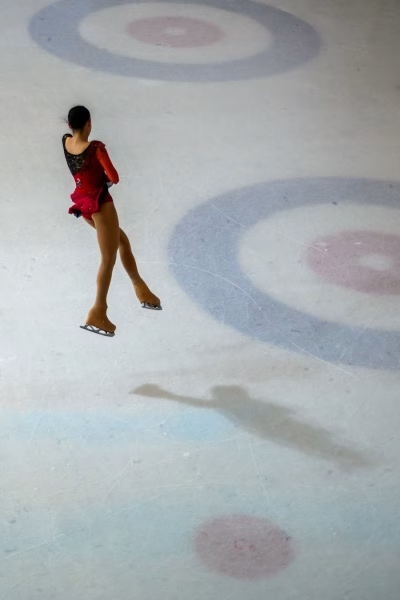
Figure skating has always asked its women to be delicate, to float, to smile, to disappear behind grace. But a new generation is carving their own language into the ice. USA Olympic figure skaters Alysa Liu, Amber Glenn and Isabeau Levito, collectively known as the “Blade Angels,” are redefining what femininity in the sport is allowed to look like, pairing technical daring with emotional intensity that refuses to fade into the background.
The Winter Olympics started on Feb. 6 in Milan and Cortina d’Amprezzo, Italy. Of the 232 American athletes, 16 were figure skaters across five events: Men’s, Women’s, Pairs, Ice Dance and the Team Event. Among them, the Blade Angels emerged not just as competitors, but as a cultural moment.
In a promotional video for the Women’s skating event, Taylor Swift endorsed the trio, spotlighting their chemistry and presence while dubbing them “American showgirls on ice.” The moment crystallized what audiences were already sensing: this was not just about medals, it was about energy, personality and spectacle.
So, who are the skaters bringing chaos, fun and fearlessness back to the rink?
Amber Glenn, an Olympic gold medalist in Women’s Singles, began skating at just five years old. She has since claimed three U.S. National Championships (2024, 2025, 2026) and the 2024 Grand Prix Final title. Beyond her accolades, Glenn is an openly LGBTQ+ athlete and a mental health advocate through her “Believe and Breathe” campaign, using her platform to speak about vulnerability in a sport that often demands perfection.
Alysa Liu, also a Women’s Singles skater, is a two-time Olympic gold medalist whose career has unfolded almost entirely in the public eye. After beginning skating at five, Liu won bronze at the 2022 Olympics in Beijing and later claimed the 2025 World Championship title. She briefly retired at just 16 years old, stepping away from a system that treated skating as an obligation rather than a passion. Her return has been marked by creative control, designing her own costumes, music and program aesthetics, and a visible shift towards skating as something lived-in and loved, not simply endured.
Often referred to as “Audrey Hepburn on ice,” Isabeau Levito made her Olympic debut this year. Known for her elegance and emotional precision, she has earned gold at the U.S. Championships and silver at both the ISU World Championships and Grand Prix Final. Levito’s presence bridges tradition and evolution, proving that softness can coexist with strength and that grace does not have to mean restraint.
In choosing presence over perfection, the Blade Angels remind us that beauty does not come at the cost of excellence. As seen during this year’s Olympics, the sport can be physically, mentally and emotionally draining.
Glenn has been openly transparent in speaking about the queer community, a visibility that has also made her a target of online harassment, leading her to quietly step back from social media. Liu has drawn heightened attention online, with some critics pushing back against her evolving skating style for straying from the sport’s traditional mold. Levito has faced similar scrutiny, with critics characterizing her balletic, delicate approach as overly restrained in an era increasingly drawn to boldness.
The reactions to Glenn, Liu and Levito reveal less about their skating and more about the impossible expectations still placed on women in the sport.
As public attitudes toward performance shift, audiences increasingly value authenticity over polish. In figure skating, this has translated into a preference for visible emotion and individuality, qualities the Blade Angels consistently bring to the ice.
The Blade Angels are not redefining figure skating by rejecting grace, but by expanding it. In choosing visibility over restraint and feeling over illusion, Glenn, Liu and Levito reveal a sport in transition, one no longer sustained by perfection alone.
On the ice, imperfection does not signal failure, it signals courage. And perhaps that is why these performances linger, not because they are flawless, but because they are felt.
In an era tired of pretending, the Blade Angels remind us that to be seen fully, imperfectly, is its own kind of triumph.
Support Student Media
Hi! I’m Hannah Planey, A Magazine’s editor-in-chief. My staff and I are committed to bringing you the most important and entertaining news from the realms of fashion, beauty and culture. We are full-time students and hard-working journalists. While we get support from the student media fee and earned revenue such as advertising, both of those continue to decline. Your generous gift of any amount will help enhance our student experience as we grow into working professionals. Please go here to donate to A Magazine.