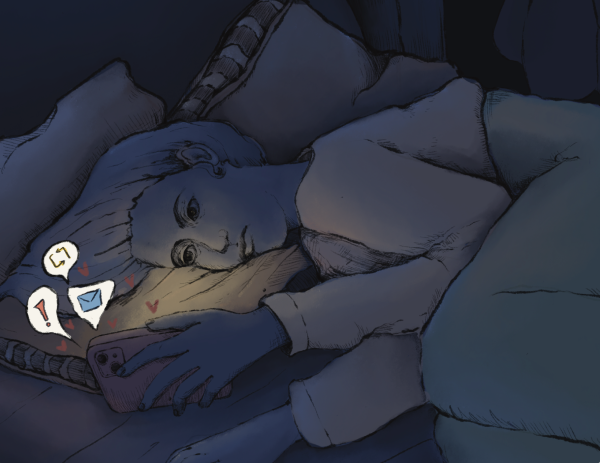
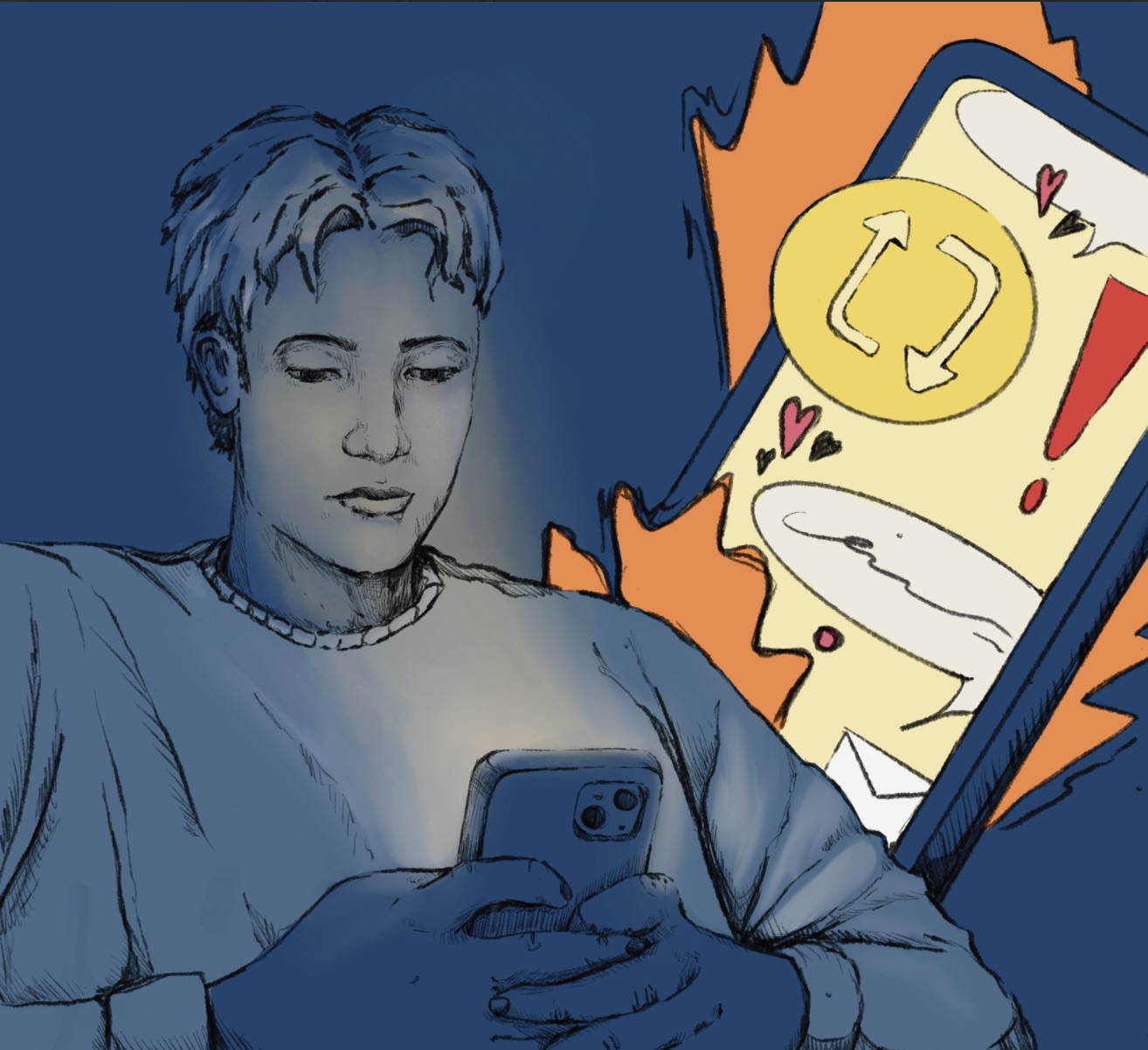
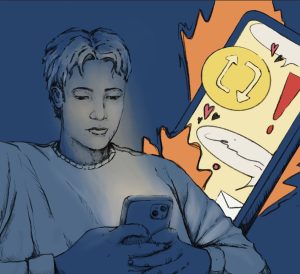
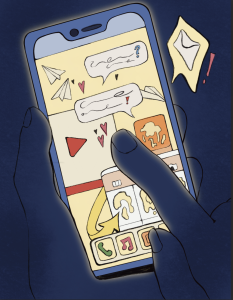
Opening social media apps usually starts with pure intentions. You plan to scroll for a few minutes, catch up on the news or entertain yourself to pass the time. Before you know it, you’re caught up in a seemingly endless cycle of negativity.
The more you scroll, the more you find yourself in a whirlwind of bad news, political conflicts and toxic drama—yet you keep scrolling.
This phenomenon, coined doomscrolling, surfaced around 2020 during the COVID-19 pandemic. In a time of unparalleled uncertainty, people were isolating themselves from others, and TikTok had just been rebranded to become the addictive app it is today.
TikTok users weren’t the only ones engaging with content at an all-time high. Chronically online users across every social media platform became caught in a spiral of upsetting news, subsequently worsening mental health rates faster than ever before.
When caught in a mind-numbing scroll, heart rates rise, palms sweat and breath quickens, pushing us toward feelings of helplessness and fear. Even with all of this occurring, the need to scroll at least one more time persists.
The Rise of Algorithms
The science behind our suspiciously accurate feeds is a result of algorithms, which identify patterns in data and use predictive modeling. Mehmet Koyutürk, a Case Western Reserve University professor in computer and data sciences, researches the development of algorithms in networks and graph-structured data.
Koyuturk said that with newer developments in artificial intelligence, algorithms have become more precise in their predictions, resulting in a feed that knows users better than they know themselves.
“It’s just the contribution of the human intelligence that is changing,” Koyuturk said. “Our contribution is getting more and more high level.”
How algorithms work on social media platforms is dependent on a few factors. TikTok starts by showing what’s most popular, but as you interact with different posts for longer periods, the algorithm starts to figure out behaviors and display topics more specific to you. Before you know it, TikTok doctors are diagnosing you with conditions you never heard of and TikTok chefs are teaching you recipes you never knew you needed.
The more time you spend on social media, the more targeted posts and ads become, according to researcher Anna Anello. Anello combines her neuroscience and computer science knowledge as a research student at the Cleveland Clinic.
“It’s really kind of scary how fast it can learn,” Anello said. “As you’re scrolling through, you’re pretty much training an algorithm to be better suited for you.”
Attention Spans are Fleeting
The role algorithms play in keeping users engaged with social media platforms is important, but it is our attention spans that have taken the brunt of it all.
Recognizing how our attention spans have been altered is crucial to understanding the power social media has over our minds. Short-from content, like Tik Tok and Reels, have shrunk our attention spans down to nothing and make it easy to scroll for hours on end, as there is something new every few seconds feeding our addiction.
Dr. Gloria Mark, a psychologist and professor at the University of California Irvine, has studied how our attention spans have shrunk over the past two decades. In an interview with the American Psychological Association, she explained how short-form content has changed how we interact with media.
“We’re just used to listening to things faster, but we do have all of this content available to us at our fingertips within milliseconds, and so perhaps we just want to sample as much as we possibly can,” Mark said.
The Addictive Side of Scrolling
According to Koyuturk, algorithms don’t always seamlessly apply the correct suggestions to your feed but often show content based on general popularity or past media interactions with other users.
“There are subtleties in our taste, but we keep being shown these suggestions again and again,” Koyuturk said. “At some point, we start clicking on them. It starts shaping our taste. Algorithms reinforce the assumption that there are certain categories of users that do behave the same.”
The idea that we are categorized by platforms meant to adjust to our likes and dislikes goes against the general concept of this technology. Algorithms don’t just adapt to fit you, but you adapt to fit them.
“Essentially, it becomes a self-fulfilling prophecy,” Koyuturk said. “It is making predictions, but it is also dictating you.”
Since algorithms cater to our assumed interests, we don’t see a variety of perspectives and different content on our feeds. We become stuck in our own bias, unable to look away from what the algorithm knows we either agree with or are horrified of.
This reasoning is why people stare at car crashes as they pass by; despite revealing negative feelings and playing with emotions, destruction and disasters command attention.
Koyuturk said this is not a simple coincidence but the specific intent of companies to profit off of this phenomenon.
“The objective of social media is not just showing you what you are likely to watch anymore,” Koyuturk said. “They optimize it in a way that the end goal is just to keep you watching.”
The addictive scrolling consuming much of our time can only be met with acts of resistance, like limiting our biased consumption habits.
The Best Ways to Escape Bad News
Anello said screen limits and bias awareness are beneficial for decreasing time spent viewing content. Being mindful while using social media is one of the best defenses against doomscrolling. Instead of scrolling to pass time, only open apps when there is a purpose.
As an occasional sufferer of doomscrolling myself, I downloaded screen limit apps at the suggestion of Anello. I first tried Apple’s own version of a screen-limit app, but I successfully found a way to ignore the notifications daily.
ScreenZen is one of the apps which received positive reviews for its ability to bring control back to users, so I tried this next. After a week of having it on my phone, I’ve been spending less time scrolling through my feeds.
While ScreenZen has worked for me, learning how to navigate addictive social media apps is a trial and error process. Finding what works for you is the best way to fight against doomscrolling.
At Anello’s suggestion, I’ve recently begun asking myself, “Why am I on this app?” and “How long will I spend doing this?” when I start scrolling. So far, these questions have helped me keep social media in perspective with reality and what I truly believe.
“You need to set limits in order to reduce your screen time, or at least go in with the knowledge that the world isn’t what it seems online,” Anello said. “It’s not completely doom and gloom. There are still good things out there.”
Ultimately, where social media platforms are headed is dependent on how we interact with algorithms. Keeping these risks in mind while online can help prevent casual scrolling from turning into doomscrolling.
The Future of Doomscrolling
Social media platforms are dependent on keeping our attention to maximize profit. At their core, these platforms rely on our satisfaction.
Doomscrolling is a byproduct of algorithm-driven platforms. Social media companies thrive off our constant engagement but do so at the cost of individuals’ mental health. Constantly watching and engaging with content curated specifically to keep us entertained negatively interacts with feelings of depression, anxiety and our curiosity.
When regularly engaging with content created to be addictive, we risk stepping into a dystopian reality where we become dependent on technology and easily fall into downward mental health spirals. However, maintaining boundaries and stepping outside of our own bias while consuming media is the most important step in working toward a healthy relationship with our feeds.
-
Illustrator: Stella Skinner
-
Support Student Media
Hi! I’m Hannah Planey, A Magazine’s editor-in-chief. My staff and I are committed to bringing you the most important and entertaining news from the realms of fashion, beauty and culture. We are full-time students and hard-working journalists. While we get support from the student media fee and earned revenue such as advertising, both of those continue to decline. Your generous gift of any amount will help enhance our student experience as we grow into working professionals. Please go here to donate to A Magazine.